Guizhou’s “Village Super League” Doesn’t Rely on Stadiums but on Popularity: Provincial Youth Training Center Sets “Mandatory Accountability If Ineffective” Rule — What Kind of Spending Will Ten Years of Waiting Force?
On October 16, 2026, the Guizhou “Village Super League” representative team and the Dong ethnic chorus performance team appeared on the campus football field of Nankai University, playing a friendly exchange match with the faculty team.
Three years ago, no one could have imagined that a grassroots team made up of ordinary villagers — farmers, truck drivers, and small business owners — could enter the football field of one of China’s top universities as an official cultural exchange delegation.
What is even more unusual is that in the same year, Guizhou did not first spend money to build a landmark large-scale youth training center. Instead, it first established a rigid rule of “investment must be evaluated for effectiveness, and ineffective investment must be held accountable,” using institutional mechanisms to block the path of “empty stadiums” first, and then reverse-engineered the construction of a province-wide football youth training system. This is completely opposite to the youth training construction path of most other provinces in China.
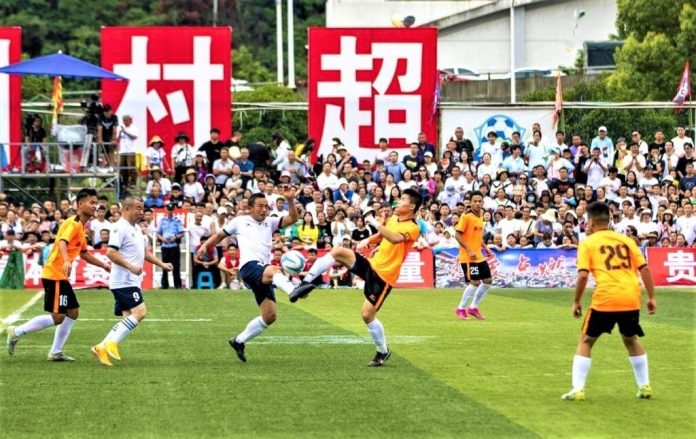
Many people’s impression of Guizhou football still remains stuck at that county-level folk tournament that suddenly went viral across the internet in the summer of 2023. But few people noticed that when the first Rongjiang Village Super League kicked off on May 13, 2023, the entire Rongjiang county had only 20 local village teams, no professional players, no commercial sponsors, and not even standard professional turf. After playing, the players had to turn around and go back to farming, running shops, or driving trucks. It was completely a competition organized spontaneously by the villagers.
No one could have predicted that such a grassroots tournament without any “professional configuration” could, in three years, push Rongjiang’s registered football players from a few hundred to over 3,000, and the number of teams from 20 to 137 — a nearly sixfold increase in three years.
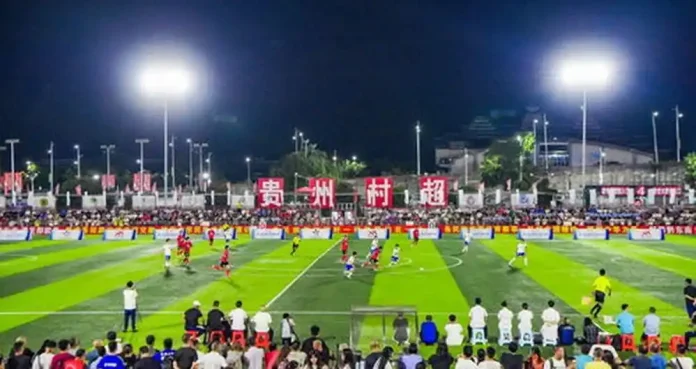
In October 2025, the Village Super League completed its first key upgrade, officially transforming from a folk tournament in one county of Rongjiang into a provincial-level league covering 9 cities and 88 districts and counties across the province, with total annual matches directly exceeding 3,000. The significance of this step goes far beyond the expansion of the tournament scale. It spread the previously localized grassroots football atmosphere in southeastern Guizhou to county-level fields across the entire province. Many children who had never been exposed to systematic football training saw, for the first time, their elders and neighbors playing formal matches on football fields near their own homes. Parents’ acceptance of their children playing football was suddenly raised. It was also from this time that Guizhou’s youth training talent selection no longer needed to start from zero. The Village Super League had already completed the popularization of football at the grassroots level through millions of spectators.
In the summer of 2026, Guizhou football’s grassroots foundation connected directly with the youth training system for the first time. At the Rongjiang Village Super League opening match on May 16, local young football players with an average age of under 14 appeared on the field for the first time. The grassroots field that originally belonged to ordinary villagers directly became a public selection site for youth training prospects. From July to August, the fourth Village Super League county-level league, the Guizhou Village Super League Championship, and the second Village Super League National Tournament were held consecutively, pushing the density and coverage of grassroots football tournaments across the province to the forefront of the country.
On July 23, in the first round of the championship placement match, the Qiandongnan team defeated the Zunyi team on penalties, and the Liupanshui team defeated the Tongren team. No team had a professional player background; all players on the field were ordinary grassroots players selected from various regions. In the August 2 final, the Qiandongnan Sour Soup Beef Team won the provincial championship. Guizhou Youth Training Director Li Zhangzhu sat on the sidelines and watched the entire match. He publicly said after the match that the grassroots competition atmosphere of the Village Super League is a key factor influencing parents’ and children’s attention to football, and he very much looks forward to children from the Village Super League host locations joining the Guizhou youth training team.
Just as the Village Super League tournament heat continued to rise, the Guizhou Sports Bureau publicized the special event subsidy projects for that year on August 7, and football-related professional events were officially included in the scope of provincial financial subsidies. This is not a randomly distributed support fund. It directly applies the logic of “input must correspond to output” to specific tournament levels. And the more critical step was the “investment must be evaluated for effectiveness, and ineffective investment must be held accountable” mechanism officially implemented during the same period. It did not first announce the investment amount and construction timetable for the youth training center, but first drew the red line of “stadiums cannot sit idle, investment cannot be wasted” in advance.
Many places in China used to follow the path of “first build a large youth training center, then recruit coaches and find players.” In the end, the stadium was built, but there were not enough young players to support daily training. The venue remained idle for a long time and became an empty shell with only a signboard but no operation. This time, Guizhou directly reversed the order: first accumulate a solid grassroots football population through the Village Super League, then use rigid rules to constrain subsequent stadium construction investment, fundamentally reducing the probability of empty stadiums.
At the county level in Guizhou, folk youth training has already run through a landing sample ahead of time. Renhuai Qiuxing Club has been deeply engaged in youth training for a full 10 years. It has now built a complete youth training echelon from U6 to U14, with more than 30 certified professional coaches, including 1 A-level coach and 7 C-level coaches. Their U11 and U12 echelons have already reached the top level in the province. Club director Zhang Yingfei said that “revitalizing the ball to serve the country” is his ultimate goal, and he hopes to help the children of the wine capital come out and see a different world through football. Li Hengchao, secretary-general of the Guizhou Provincial Football Association, also publicly affirmed the results of this folk youth training institution. Its experience directly proves that there is no need to concentrate on building a super-large stadium in the provincial capital; youth training institutions rooted in counties can also cultivate high-level young players.
Guizhou did not follow the traditional youth training path of concentrating all good prospects in the provincial capital for closed training. Instead, it implemented the “provincial team run by schools” model, allowing outstanding young players to complete their studies in local schools while receiving systematic football training. This model directly solves the pain points of traditional youth training such as interrupted education and high family investment caused by players moving to other places, and also reduces the problem of a large number of good local prospects outflowing. Renhuai Qiuxing Club has reached cooperation with the local education and sports bureau, obtained special funding support, and directly entered multiple local primary and secondary schools to carry out football popularization courses, extending the tentacles of youth training directly into children’s daily campus life.
During the 2026 National Day period, the Village Super League “Global Village” International Football Open officially concluded. 551 grassroots players from 36 countries and regions came to Rongjiang to participate. During the halftime break, intangible cultural heritage performances such as Dong ethnic songs and Miao Lusheng dance were placed together with football matches. The Village Super League has grown from a domestic folk tournament into an international grassroots football exchange platform. The Guizhou Provincial Sports Industry High-Quality Development Implementation Opinions released in October clarified that by 2028, the province’s total sports industry scale will strive to reach 48 billion yuan, and by 2030 exceed 60 billion yuan, with football-related events clearly listed as a core component.
Currently, regarding the specific site selection, start date, and investment scale of the provincial youth training center, there is no official information to prove the previous claim by some non-official media that construction would start by the end of 2026. The four-tier Village Super League tournament system has entered normalized operation. The next confirmed public arrangement is the third “Belt and Road” International Football Invitational Tournament to be launched in the second half of 2026, which plans to invite more than 20 overseas teams to participate.
From the riverbanks and terraced fields where villagers spontaneously played football, to the province-wide youth training system, the path Guizhou football has taken has never relied on landmark stadiums built of steel and concrete to prop up appearances. Now it has used a rigid accountability mechanism to block the possibility of “empty shelling” at the door.